
Barren County Arrest Records and Charges
Barren County arrest records begin on the law-enforcement and custody side. An arrest can create booking details, identification checks, custody status, bond context, and jail or sheriff records. The official sources reviewed found the Barren County Sheriff website and the Barren County KY Jail site, but did not locate an official public inmate-search form, current roster table, or app-store inmate lookup. That means official custody details may require direct jail, sheriff, or court contact rather than a public roster search.
Court charge records are different. Once a complaint, citation, information, indictment, or warrant-related filing enters the court system, the charge becomes part of the court case. The court side may show offense name, statute or citation reference, arresting agency, division, bond, next hearing, and whether the charge was amended, reduced, dismissed, bound over, diverted, disposed, or sentenced. For the full case file and outcome, use Barren County criminal court records.
Find Barren County Arrest Records
The best official search path depends on whether the need is custody, charge status, or final case outcome. The county jail site confirms the Barren County KY Jail identity, jailer Aaron Shirley, public channels, and contact email in the app configuration, but no public roster form was found in the inspected official source. The court record path starts with the Kentucky Trial Court Docket search, Kentucky ePay for eligible citation or payment matters, and the Circuit Court Clerk for official file copies.
- For custody or booking status, start with the official jail or sheriff channel and avoid unofficial jail lists.
- For court charges after arrest, search the Kentucky docket by BARREN, division, and date.
- Use ePay when the matter may involve a citation, eligible fine, cost, fee, or case-number payment search.
- Ask the Circuit Court Clerk for the complaint, citation, indictment, bond order, docket, disposition, or certified copy.
- Use Kentucky DOC KOOL only if the person may be a sentenced state inmate rather than in county pretrial custody.
The official jail configuration source at Barren County KY Jail app configuration is shown below because it confirms the public jail web channel without supporting a claim that a roster search exists.
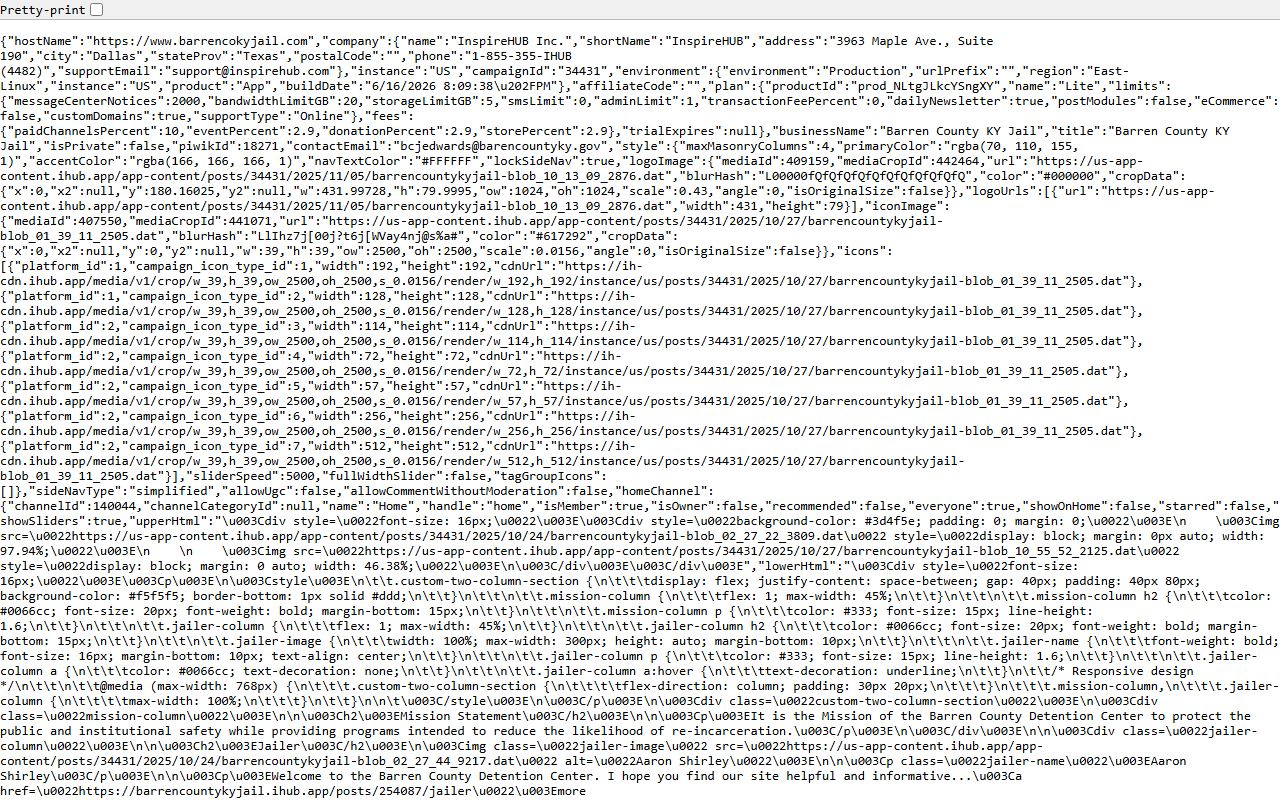
That distinction matters. A public jail web presence is not the same as a verified inmate roster, booking-photo search, or warrant lookup.
Charges After Arrest in Barren County
Charges after arrest move the event from custody into the court record. Law enforcement may issue a citation or support a complaint. A prosecutor may proceed, amend, dismiss, divert, or reduce charges. A grand jury may return an indictment for felony prosecution. Kentucky uses County Attorneys and Commonwealth's Attorneys rather than District Attorney terminology, so Barren County charge records should not be read through a generic DA model.
| Complaint | Information | Indictment | |
|---|---|---|---|
| Filed by | Law enforcement or prosecutor based on the alleged facts. | Prosecutor when the matter proceeds by formal accusation. | Grand jury after felony review. |
| Common use | Citation, warrant, misdemeanor, or preliminary criminal filing context. | Formal prosecution where allowed by procedure. | Serious felony cases moving into Circuit Court. |
| Where it appears | District Court or related case file. | Case file and docket entries. | Circuit Court felony case file. |
| Why it matters | Starts or supports the charge record. | Defines the filed accusation. | Moves felony prosecution into the higher trial court. |
Felony matters may first appear in District Court for arraignment or probable-cause proceedings, then move to Circuit Court if indicted or bound over. Misdemeanors and violations usually remain in District Court. Traffic and ordinance charges also commonly sit in District Court unless another case path changes the record.
Barren County Charge Status
Charge status is the part of the record that explains what happened to each allegation. One arrest can produce more than one charge. One case can have a mix of outcomes: one charge dismissed, one amended, one diverted, and one disposed by plea or conviction. That is why charge status should be read charge by charge, not just case by case.
| Status | What It Means |
|---|---|
| Pending | The charge remains active and no final disposition is shown. |
| Amended | The charge was changed, often to a different offense, count, or severity level. |
| Reduced | The prosecutor or court process moved the allegation to a lower offense or level. |
| Dismissed | The charge was ended without a conviction on that count. |
| Bound over | A felony matter moved from District Court toward Circuit Court prosecution. |
| Disposed | The court recorded an outcome such as conviction, acquittal, diversion, or dismissal. |
Note: A charge status can change after the first docket entry, so verify old results with the court clerk.
Charges vs Convictions
A Barren County arrest record or charge record should not be treated as proof of conviction. Charges are allegations. Convictions are outcomes. The court record can show whether a person was charged and still have no conviction because the charge was dismissed, amended, diverted, or resolved by acquittal. The final disposition and sentence entries are the key fields for outcome research.
| Charge | Conviction | |
|---|---|---|
| Record stage | Filed after arrest, citation, complaint, or indictment. | Entered after plea, verdict, or qualifying court finding. |
| What it proves | An allegation was filed in court. | The court reached a guilty or conviction outcome. |
| Can it disappear? | It may be dismissed, amended, reduced, or expunged if eligible. | It may later be appealed, modified, probated, or expunged if eligible. |
| Where to verify | Charging document and docket. | Disposition, judgment, sentence, and clerk-certified record. |
Barren County Charge Record Fields
The fields most often needed for court charges after arrest are practical match points. They help separate people with similar names and help the clerk locate the right file. Use exact spelling, approximate arrest or filing date, citation number, warrant number, case number, and date of birth only when an official office requires it for matching.
- Defendant name and court case number identify the court file.
- Offense name, statute, citation number, or warrant number identify the charge.
- Arresting agency and court division help separate custody records from court records.
- Bond, release, or pretrial entries show appearance and custody conditions.
- Hearing date, courtroom, and event type show the next case step.
- Disposition and sentence fields show the result once the charge is resolved.
Statewide Charge and Custody Lookups
Statewide tools can support charge research, but they do not replace the Barren County court case file. Kentucky DOC KOOL is for sentenced state offenders, not a county jail roster. Kentucky State Police sex offender registry records are registry records, not the criminal case file. Kentucky ePay can help with eligible citations and payments, but payment alone should not be assumed to clear a warrant, charge, or court-date problem unless the clerk confirms it.
The Circuit Court Clerk is the official local route for Circuit and District Court files. The Barren County Sheriff and jail channels are relevant for law-enforcement and custody questions. The County Clerk is not the court-charge custodian. Its land-record, DocAlert, and eCCLIX tools are for county recorded documents such as deeds, mortgages, liens, releases, wills recorded in legal records, and similar filings.
Sealed or Expunged Arrest Records
Sealing and expungement can affect both the visibility of court charges and the practical public record left after an arrest. Kentucky expungement paths include eligible felony and misdemeanor convictions under KRS 431.073 and certain acquittal or dismissal-with-prejudice outcomes under KRS 431.076. Eligibility depends on the exact charge, outcome, waiting period, and court process, so a public search result should not be used to predict eligibility.
| Sealed | Expunged | |
|---|---|---|
| Public access | General access is blocked or limited. | Public access is removed or restricted after the order is processed. |
| Typical reason | Confidential record, court order, juvenile status, or protected information. | Eligible outcome under Kentucky expungement law. |
| Where to ask | Office of Circuit Court Clerk. | Kentucky Court of Justice expungement resources and Circuit Court Clerk. |
| Search result effect | Details may be hidden or redacted. | The public record may no longer appear through ordinary lookup paths. |
Restricted Barren County Charge Records
Not all arrest and charge information is public. Juvenile matters, sealed records, expunged records, mental-health details, victim addresses, minor identities, protected personal identifiers, medical information, and some active-investigation material can be withheld or redacted. A public docket can omit details even when a case exists. A clerk may also require proof of identity, party status, attorney status, or a court order.
Kentucky's public-record framework includes KRS 61.870, KRS 61.872, and KRS 61.878. The charge itself may be a public court entry, but exempt or protected details can still be redacted. That is especially important when an arrest did not lead to conviction or when a record has later been sealed or expunged.